The Quiet Craft of Mending: Rediscovering Repair Rituals for Slower Weekends
Repairing something by hand can feel like a quiet rebellion against a disposable culture. For centuries ordinary people kept clothes, tools, and household goods going through small, thoughtful interventions. Those historical practices were not only practical; they shaped a slower, more attentive relationship with material things. Here’s a compact guide—framed as problem, principles, examples, and a brief practice checklist—to bring that ethos into a weekend routine.
Problem
The modern problem is simple: many of us live surrounded by easily replaceable objects and little time or confidence for repair. Fast fashion, mass-produced furniture, and inexpensive electronics encourage a throwaway mindset. When an item fails, the default becomes disposal rather than mending. That leads to wasted resources, a loss of skill, and fewer opportunities for satisfying, focused work that slows the mind.
Principles
- Start small. Repairs don’t need to be perfect restorations. Begin with one sock, one seam, or one loose chair leg.
- Observe before acting. Spend a few minutes examining the damage: where the stress concentrates, how the material behaves, what tools might help.
- Respect materials. Use stitches, adhesives, and patches suited to the original fabric or wood; gentle techniques often outlive aggressive fixes.
- Value visible repair. Many traditions treat repairs as part of an object’s life story—visible mending can be an aesthetic choice rather than a flaw to hide.
- Practice iteration. Repair is a learning process. Expect better results with repetition, not instant mastery.
Examples
History offers an array of repair traditions that translate easily to the home workshop.
Sashiko and visible mending
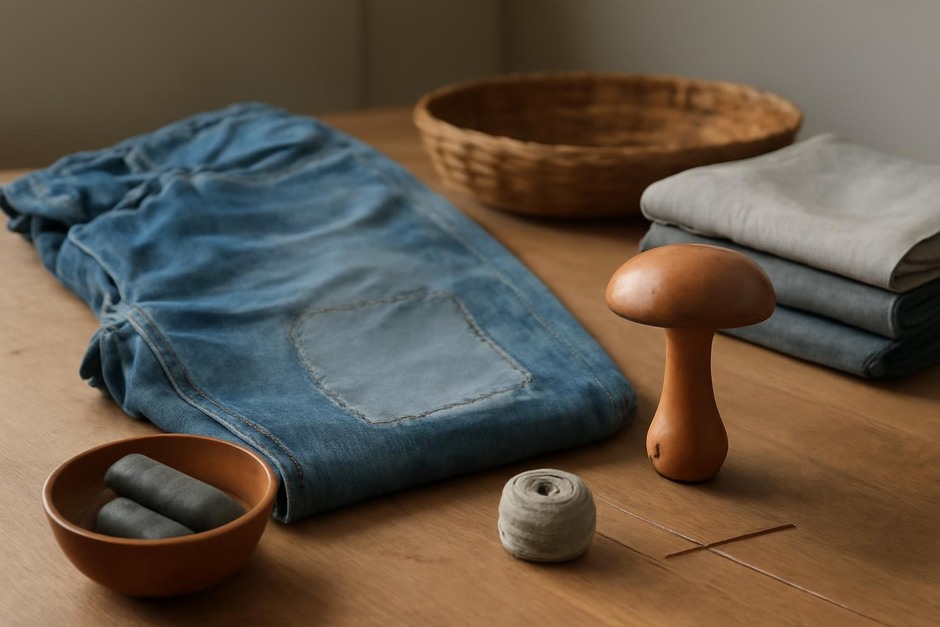
Originating in rural Japan, sashiko began as reinforcement stitching for work garments. Small, regular stitches form geometric patterns that bind layers of fabric. Today, the same approach can be used to patch denim or reinforce elbows: a simple running stitch, repeated rows, and contrasting thread turn a wear point into a deliberate feature.
Kintsugi’s philosophy
Kintsugi is the Japanese practice of repairing broken ceramics with lacquer and gold, embracing the break as part of an object’s history. You don’t need lacquer and powdered gold to borrow its lesson: a thoughtfully chosen adhesive or decorative seam can celebrate repair rather than hiding it. Modern ceramic repair kits provide safer, accessible alternatives if you want a similar effect.
Darning and sock repair
Darning a sock exemplifies the “small, focused task.” Using a darning mushroom or simple rounded form, a needle, and thread, you weave new material across a worn area. The result is functional and, when done with contrasting thread, visually interesting—an honest, useful mark of care.
Wood and furniture touch-ups
Historic households regularly tightened joints and re-glued chairs. Today, a weekend can revive a wobbly stool with wood glue, clamps, light sanding, and a bit of finish. These are low-cost interventions that restore utility and extend an object’s life.
Practice Checklist
For a relaxed, instructive weekend mending session, follow this concise checklist:
- Choose one small project: a sock, a torn hem, a denim hole, or one loose joint on a wooden chair.
- Gather basic tools: needle, thread (cotton or polyester to match use), scissors, darning mushroom or small wooden form, patches, wood glue (PVA) and clamps if needed, sandpaper, and a marker to outline the repair area.
- Examine the item for underlying issues (weak fabric around a hole, missing stitches, split glue joints) and decide whether reinforcement or replacement material is best.
- Test your chosen stitch or adhesive on a scrap if possible. Practice a few rows of running stitch, backstitch, or weaving to get comfortable.
- Execute the repair slowly: take deliberate, consistent stitches, or apply glue sparingly and clamp for the recommended time.
- Make a visible choice: match the original or make the repair a deliberate accent with contrasting thread or patterned sashiko rows.
- Finish and reflect: trim loose threads, sand and touch up finishes, and note what worked for next time.
Mending is a practical skill and an invitation to slow down. Even short, simple repairs reconnect you to the objects you use daily, teach patience, and leave a subtle human trace. Take one hour or one afternoon this weekend: pick a small piece to repair, follow these principles, and let the process be the point rather than a race to perfection.